• Evanston Green Ball is Friday, May 31

    Posted on May 24th, 2013 tsevilla No comments

    Evanston Green Ball

    As a supporter of green causes, Nature’s Perspective invites everyone to join us at the 2nd annual Evanston Green Ball, a festive casual evening to support the Evanston Ecology Center and its programs, brought to you by The Evanston Environmental Association and the City of Evanston. The event features:

    • “Taste of Evanston” with appetizers from from top local restaurants/caterers, beverages from Goose Island, WineStyles, and Green River
    • Live music from Jonas Friddle and the Majority
    • Showcase of local “Green Groups”
    • Raffle prizes

    Tickets sold out last year, so get your tickets early. Visit www.evanstonenvironment.org/greenball.html for details.

  • Fresh New Plants For A New Season

    Posted on May 24th, 2013 tsevilla No comments

    Each year there are countless plant varieties that are introduced to the green industry. They all look wonderful in catalogs, but we choose carefully. After a year or two on trial in our garden, we let everyone have a chance to enjoy them at home. Here are some of the recent additions to our nursery.

    Vines

    The Raymond Evison® series of Clematis is the result of 50 years of breeding, offering colorful flowering vines that are beautiful, very hardy and bloom a long time. Their smaller stature makes them ideal to plant near a patio to be appreciated up-close during summer months. Last year in Barb’s garden, they bloomed in June and July… and re-bloomed again in September and October! Some of our favorites: ‘Abeline’ (3-4′ h) with deep pink flowers with yellow anthers, and deep pink stripes appears as the flowers fade; ‘Crystal Fountain’ (6′ h) with double lilac blue flowers with large anthers, giving blooms a full, ruffled appearance; ‘Cezanne’ (3-4′ h), which has lavender blue flowers with a yellow center; and ‘Rebecca’ (6-8′ h) with impressive, 5-inch deep magenta-red blooms.

    Golden Hops is another vine that makes quite a statement in a garden and is perfect for beer lovers and home brewers. Easily grown in a full sun location, it quickly covers an arbor with bright chartreuse foliage. Its vigorous growth may require regular cutting back for maintenance. Hops are ready to be harvested in the fall, dried and used in home brewing.

    Shrubs

    Looking for something to delight your senses from spring to frost? We’ve got two easy-care, long-blooming roses with wonderfully fragrant flowers. Miracle Sensation Shrub Rose has delightful, single pink flowers, while Milwaukee’s Calatrava Rose bears pure white, double flowers fading to pink. Both grow 3-4 feet tall.

    To add pizazz between smaller perennials and large shrubs in a shade location, Bobo Dwarf Hydrangea is ideal. Small in size, growing only 3 feet tall, it’s big in presence, covered in large, cone-shaped white flowers that fade to pink. The flowers, held on strong stems, even appear to grow longer as they bloom for weeks!

    Rufa Bamboo imparts a distinctive Asian feel and makes a pretty focal point by itself, or massed as a hedge. Graceful and well-behaved, clump-forming and non-invasive, it grows 4-6 feet tall, and can thrive in either sun or shade. Another plus: it stays evergreen even in winter.

    Trees

    Two Kousa dogwoods are not particularly new to us… but could make the perfect new addition to your garden, with their pretty flowers, beautiful horizontal branching habit and wonderful fall color. Heart Throb Dogwood offers large deep pink flowers in summer and brilliant red leaves in fall. Samzam Dogwood has clear white flowers in summer, and wavy, variegated leaves that turn burgundy in fall. Both mature to 15-20 feet tall, and require sun.

    Columnar Purple Beech, with its dramatic, dark purple foliage and tight, neat upright habit, is perfect for tight spaces and screening. Slow-growing to 40 feet.

    Ryusen Weeping Japanese Maple, makes a wonderful accent in a part shade garden bed, with its cascading, bright green, palm-shaped leaves that turn a vibrant orange-red in the fall. Grows to 10 feet tall.

    These are just a few of the endless plants that are available in our nursery. Our landscape designers can help you create the perfect combination of plants to express your personality and tastes, while enhancing your property.


  • Three GardenTasks For Big Impact

    Posted on April 12th, 2013 tsevilla No comments

    Attending to your bed lines, lawn and old shrubs now will give your garden a great start to the growing season.

    Take a look out your window. How is your garden looking? If you feel like it’s lacking, but you’re not quite sure where to begin, here are three things that can be done now. Attending to your garden’s bed lines, lawn and old shrubs will make a big impact in your garden as the weather warms up and the season of outdoor living nears.

    Formalize Bed Edges

    Well defined, crisp, clean bed lines set a landscape apart. When there is no clear separation and balance in the yard, everything seems to run together with a lack of form. Mowing the lawn is a much more difficult task and the lawn inevitably creeps into the planting beds. By using large, sweeping, defined bed lines, the overall look of the landscape is simplified and the eye is not confused. Spade edged beds should be established and maintained at a depth of 4-6”, then mulched or planted with groundcover or perennials to prevent weed growth and conserve soil moisture.

    Aerate and Overseed Your Lawn

    Nothing gives more visual impact to your landscape than a beautiful, lush lawn. The best way for a thriving and healthy lawn is to win the battle against the weeds by core aerating and overseeding.

    Soil compaction is a major ally to weedy species taking over an established lawn, and for this reason, it is important to core aerate every year. It is the single best thing you can do for your lawn. Core aeration not only allows new germination of seed to happen faster, but it strengthens the plants that exist already by breaking up the thatch layer and allowing each plant to put out new growth. Your lawn is in a constant battle between the desirable turf grass species and the undesirable weedy species that try to invade; and the strongest army will usually win the war.

    Bring in more troops (or plants in this case) than your enemy by consistently overseeding the weak areas of your lawn in both spring and fall with high quality grass seed. Make sure you are using the appropriate seed for the particular area of your property. Shade is prevalent along the North Shore, and shade seed is readily available. You will attain considerably better results establishing a lasting lawn in the shade with the right seed. Overseeding yields the best results when seed is pre-mixed with a mixture of organic matter such as compost and a medium to retain moisture, such as peat moss. It is appropriate to mix these in a 1/3 ratio and spread around patchy areas of the lawn. This mixture improves seed to soil contact, protects bare seed from being blown away or easily eaten by birds, and allows the seed to be surrounded by moisture for a much longer period after irrigation.

    Prune Old Shrubs

    Whether it is a 30-year old Forsythia, a 15-foot tall Dogwood hedge or leggy Spirea, nothing sends your old landscape shrubs to the fountain of youth like a good hard pruning. Rejuvenation pruning refers to cutting the majority of the plant back, sometimes to the ground, sometimes just to the primary branch separation, so that vigorous new growth will sprout out. This will promote better overall plant structure, larger and more abundant blooms on flowering species and decrease pruning frequency associated with the plant. This should be done as early as possible in spring, so all the energy in a shrub’s roots can be diverted into developing new shoots instead.

    Completing these tasks will start a good foundation for your garden’s development. Next post, we’ll show you wonderful new plant introductions to enhance your outdoor living.


  • Announcing Our New Website

    Posted on April 5th, 2013 tsevilla No comments

    www.naturesperspective.com

    We’re proud to announce the release of our new and improved website, www.naturesperspective.com.

    While this online newsletter shares timely information on new plants, products, projects we’ve undertaken and such, our website shares more details on what our company is all about, and features more photo galleries for landscape design ideas.

    You’ll find more information about our services, service area, how we work and the design process, the many ways we take part in green solutions and more.

    Our portfolio has been updated to include more recently completed projects. It has six categories: Entrances, Gardens, Hard Surfaces, Structures & Accessories, Water Features and Maintenance. You can read about landscaping challenges we met and addressed in the Case Studies section, which features before and after photos.

    We hope you enjoy our new look (and possibly discover your own garden featured in our website)!

  • Downy Mildew Causing Many To Lose Impatiens

    Posted on March 14th, 2013 tsevilla No comments

    Last year, we encountered a widespread, extremely destructive disease called Impatiens Downy Mildew, affecting Impatiens walleriana (common impatiens). It is an aggressive and easily spread disease that causes the plant to lose its leaves and eventually die. Some of you may have encountered this at your property last summer. Downy mildew is not easy to detect in its early stages, so by the time you know you have it, it’s likely to have infected all of your impatiens. The disease has impacted impatiens in other parts of the United States for several years now, but first became a problem here during the 2012 planting season.

    Infected plants will develop yellow spots on the leaves and appear to be unhealthy. An examination will reveal white spores on the underside of the leaves, which soon will begin to drop from the stems. The disease can be controlled in a greenhouse environment with use of fungicides, but the effects of the fungicides lessen with time. Impatiens that appear healthy upon purchase can deteriorate quickly once they’re planted at home. Established, downy mildew spores can be spread by the wind, blowing from site to site easily infecting other impatiens. Fortunately, the disease does not spread to other plant varieties, including New Guinea impatiens. Because the disease is so difficult to prevent and control, the only real solution seems to be not planting impatiens.

    Alternatives

    Fortunately, there are many common shade-loving annuals that make great alternatives to planting impatiens. New Guinea Impatiens, Reiger Begonias, Coleus, Caladium, Tuberous Begonia ‘Non-Stop’ varieties, Impatiens Hybrids ‘Fusion’ series are just a few of the wonderful alternatives to select from

    Perennials are also an excellent alternative to seasonal annuals. Although the upfront cost may be higher, selecting plants that return each year provides a lower-maintenance, longer-lived, sound solution. Two perennial groundcovers we recommend are Creeping Vinca, covered with periwinkle blue flowers in spring, and Lamium, a lower-growing groundcover with interesting foliage and lovely white, pink or purple flowers. There are many shade-loving perennials to choose from that bring color and are suited to different soil types. Dry shade areas will benefit from tough Hosta like ‘June’ and ‘Paradigm’, with fancy foliage and lavender colored blooms. Wet areas will allow Astilbe to thrive; ‘Purple Candles’ has bold fuchsia-pink flowers, while ‘Peach Blossom’ has delicate peach-pink. Well-drained conditions would work perfectly for Coralbells like ‘Caramel’ and ‘Tiramisu’, which have beautiful leaves of orange, purple, yellow and green.

    Impatiens have been a garden staple for many years and it is unfortunate that the disease has decimated our area. We look forward to the day when a downy mildew-resistant strain of Impatiens walleriana is developed and we can confidently bring them back.


  • Case Study: Updated and Refined

    Posted on March 14th, 2013 tsevilla No comments

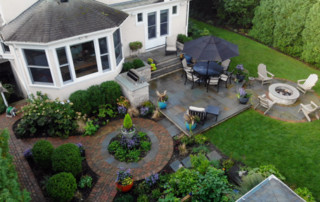
    Like many of our clients with newer homes in older established neighborhoods, this family had to make a decision whether to move to a home with a yard more suited to their tastes, or to stay put and customize their landscape from the one they inherited from the builder and previous owners. What they desired was a backyard that would accommodate their needs to entertain large groups of their friends and family, but still left a large enough lawn and play area for their children.

    We worked with them to create outdoor spaces that reflect the architecture of their home, a patio that would fit their woven wicker furniture and that would incorporate richer materials and more refined details that would be reminiscent of the East Coast where they were from.

    We started by making templates of their existing patio furniture and gas grill. The directive was to create three distinct spaces on the patio: a dining area, an outdoor living room and a sunning area. The original rear stoops and steps were falling apart and unsafe. They were replaced with new bluestone-clad steps and landings. The front steps also incorporate slate-like Richcliff concrete pavers which are repeated on the rear patio. A new recycled clay paver walk leads guests from the front of the house to the new patio. A charming cedar gate and low-voltage Concord light fixtures from Kichler add an early Colonial flair and beckon you into the rear yard.

    New plantings provide color and a fresh look to complete this makeover, and our clients love their elegant, expansive outdoor environs.


  • A Plant You Should Know: Butterflies Magnolia

    Posted on March 14th, 2013 tsevilla No comments

    Nothing celebrates the season of spring quite like a big, flowering Magnolia tree, with its branches covered with hundreds of large flowers. Pink and white-flowering Magnolias are common varieties in our area. In this post, we take notice of a less common, yellow-flowering variety, Magnolia acuminata ‘Butterflies’, or Butterflies Magnolia.

    Butterflies Magnolia is very hardy in our area, and in late May, it blooms with 4- to 5-inch, upright, creamy yellow double flowers, resembling butterflies resting on branches. After flowers have bloomed, bold dark green leaves follow. It has a neat, pyramidal form and reaches a mature height of 20 feet. A sheltered location is best, organically enriched soil is preferred, in full sun to partial shade.

    Since it blooms in late May, after any frost danger has passed, spring is a great time to introduce it to your garden.

  • Local Garden Gem: Garfield Park Conservatory

    Posted on February 19th, 2013 tsevilla No comments

    Looking to get away from the dreariness of winter, with its barren trees and frozen, snow-covered lawns? Chicago has a warm and inviting respite, and it’s called Garfield Park Conservatory.

    Unlike the North Side’s smaller Lincoln Park Conservatory, Garfield Park Conservatory is tremendous, sitting on four and a half acres in the redeveloping West Side at 300 N. Central Park Avenue. Designed by legendary landscape architect Jens Jensen in collaboration with Prairie School architects Schmidt, Garden and Martin and the engineering firm of Hitchings and Company, the building’s low, mounded architectural design is reminiscent of Midwestern haystacks. It was completed in 1907 and houses a mind-boggling array of plants from all over the world, grouped in a series of wonderfully designed, naturalistic landscapes. Enlightening, educational and always evolving, it is enjoyable for visitors of all ages.

    Once inside the conservatory, you’ll be peeling off your winter wear upon entering The Palm House, a warm tropical paradise where huge palms tower over you to touch vaulted ceilings.

    Towering over visitors, the Scheelea Palm in the background is the oldest, largest palm tree in the conservatory.

    The Aroid House is home to what many will recognize as popular houseplants. Its hidden gem here is the Persian Pool, a tranquil, man-made lagoon with a sitting area, koi and yellow glass lily pads created by world-renowned glass artist Dale Chihuly.

    On a quiet day, one can find much solace and contemplation by sitting on the bench next to the Persian Pool.

    The Elizabeth Morse Genius Children’s Garden is an indoor setting for families and children to have fun, with spray bottles for kids to mist plants, interactive exhibits and a confined play area for toddlers.

    Children will find the Elizabeth Morse Genius Children’s Museum a lush, wonderful place to play and discover.

    The Children’s Museum has plenty of children’s activities to instill a love of nature. Here children make beaded test tubes with Pothos cuttings.

    Trick-or-treaters are thrilled during the annual Creatures of the Night event, which brings nocturnal animals to experience up-close.

    Want to take a glimpse of what Chicago might have looked like millions of years ago? Take a winding stroll through The Fern Room, with its various ferns, ancient cycads, mossy rocks and waterfalls.

    Take a prehistoric trip through Chicago in The Fern Room.

    We can go on and on, but don’t want to spoil the surprise. You can plan a visit to coincide with upcoming events happening at the conservatory. Street parking is meter-free, and there is usually space available in the free parking lot just south of the main entrance. There is no coat check nor lockers to put away your coats, so it helps to have a big tote bag to store them and carry along with you. A stroller can also do the job but can be unwieldy on stepstone paths.

    A terrible hail storm on June 30, 2011 damaged countless glass panes of the conservatory, and a massive restoration effort is under way. Donations are welcome.

    For more information visit www.garfieldconservatory.org.

  • Budgeting For a Landscape Investment

    Posted on February 18th, 2013 tsevilla No comments

    The recent Chicago Auto Show showcased a dazzling variety of cars in all kinds of price ranges. Some visitors may have been there looking for a new car, with a budget in mind, while others went to dream about the possibilities.

    Since spring is only a few weeks away (and you’ve found yourself reading our blog), you may already be thinking of landscaping your property this year. If you are considering using a professional for installation or maintenance services, it is helpful to think of budgeting for a landscape investment in a similar way to budgeting for a car.

    There are times when you know you need to put some money away to maintain or purchase a vehicle. Maybe your worn-out sedan is crossing the 200,000 mile mark, or your family just outgrew the minivan. In determining your goals, you need to decide if you are going to downsize from the minivan you have been driving since the last millennium… or maybe it’s time to consider the sporty coupe you have been eyeing for years. Whatever the reason for your being ready to shop, you have to consider a budget range before shopping.

    Maintain?

    Considering maintenance? It is no different than when speaking with a landscape consultant. It is important to look at your needs in the same terms as spending money on your existing car. Are you looking for an “oil change”, “new wiper blades” or “transmission flush”? These are necessary periodic maintenance visits, with relatively small monthly costs involved. $0-$300.

    This is similar to your typical landscape maintenance visit. These services involve mowing, pruning, fertilizing and spring/fall clean-up visits. These services can be presented in a seasonal cost, or spread out over a number of months.

    Upgrade?

    Thinking of making small improvements to your vehicle to make it last a bit longer? Maybe you are not budgeting for a new car, but need to spend more than the typical maintenance costs to extend the life of what you have. The same principles exist your with your property. If you have made the decision to live in your home for years to come, landscape enhancements are often considered to update the look of your property. Consider improvements in your landscape in the same budget range as what you would spend on improving and extending the life of the car you are driving.

    These enhancements are typically small plantings, hardscape projects, installing landscape lighting or possibly a small water feature added to the garden. $500-$3,000.

    Start anew?

    Or, are you considering purchasing a new car? If you decide to buy a new car, you have to decide on a feasible price range. Most people realize the price difference between a GM sedan and a BMW sedan, and know which one they will be able to afford.

    This is a harder distinction to make when developing a landscape plan. Just like buying a car, it is important to set a realistic budget.  You may not know what landscaping costs, but you know what cars cost.  The two costs are very much the same. Some comparisons:

    A nice landscape project can be accomplished for the price of a used car. $3,000-$15,000.

    A complete landscape design and installation is about the price of a popular new car. $15,000-$35,000.

    The larger and more detailed your project, the closer you get to the price range of premium class luxury cars. Upwards of $35,000+ 

    A Budget Refines Your Project

    It is important that you provide your designer/salesman with a price range so that they can realistically propose concepts that you will be able to conceivably purchase.

    You won’t be interested in the economy car, when you have the budget and desire for the luxury car (or vice versa).

    Some base models may be $40k, but you might be test driving the one that is $60k. Plan a budget range and discuss it with your landscape designer.  With this guidance, you will be presented with a design that will fit your expectations and not one that will break the bank.

    Allow your designer to conceptualize with a budget in mind.  Your time spent in the preliminary stages of design will be much more effective and productive if you are on the same budget page.

    Whether you are going to the mechanic, dealership, landscape designer or maintenance manager, it’s going to be an investment in time and money to find the best fit for you. Be open and honest with your designer, and they will strive to build you the best project within your budget. In the end, a good full-service landscape contractor aims for complete satisfaction with your landscape investment, and will strive to keep it looking great for years to come.

  • Case Study: Cottage Garden With Curb Appeal

    Posted on January 16th, 2013 tsevilla No comments

    Our clients purchased this charming 1920’s Dutch colonial house with plans of making it their own.

    The existing landscape consisted of a traditional front lawn with overgrown shrubs and a scattering of perennials. Our clients wanted to simplify the maintenance, add curb appeal and create a garden for all to enjoy.

    After remodeling the home’s façade, they were ready for a fresh look for the front yard. We removed the lawn and plantings, saving some perennials to transplant. Removing the overgrown plant material revealed a beautiful stacked limestone retaining wall. A new paver sidewalk and sitting area were installed to provide a place for the homeowners to enjoy their garden and chat with passersby. Stepping stones tie the areas together and allow one to meander through the lush cottage garden. A mixture of evergreens, hydrangeas, roses, grasses and perennials were added to create a year-long showcase and welcome birds, bees and butterflies. Containers of colorful annuals, landscape lighting and drip irrigation complete the garden rejuvenation.